Shipping
Same-day shipping on USA orders placed before 2PM EST.
View Shipping Policy →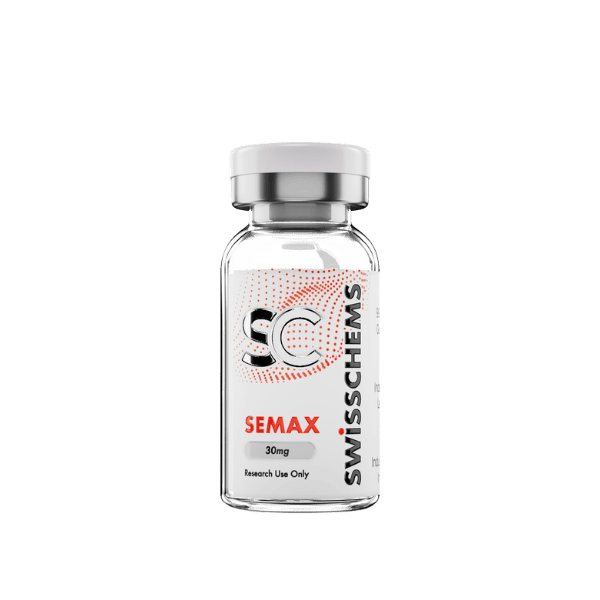
SKU: SEMAX-30M
Semax 30 mg should be reconstituted with bacteriostatic water (BAC).

Same-day shipping on USA orders placed before 2PM EST.
View Shipping Policy →30-day hassle-free returns on unopened products.
View Returns Policy →Every batch is tested for purity, potency and quality.
View Lab Results →Have a question? Our team is here to help you.
Contact Us →Semax (MEHFPGP) is a synthetic heptapeptide analogue of the ACTH(4-10) fragment developed to retain specific peptide-signaling properties while exhibiting a distinct pharmacological profile. Experimental investigations have examined its interactions with melanocortin-associated signaling pathways, peptide-mediated regulatory networks, transcriptional control mechanisms, and signal transduction processes. Studies have also explored its influence on molecular signaling systems, receptor-associated regulatory pathways, and peptide-dependent cellular communication mechanisms. Research applications include neuropeptide pharmacology, melanocortin pathway investigation, peptide-signaling research, transcriptional regulation studies, receptor-ligand interaction analysis, and mechanistic evaluation of peptide-mediated signaling systems.
| Chemical Formula | C37H51N9O10S |
|---|---|
| Synonyms | MEHFPGP, (Pro8,Gly9,Pro10)ACTH-(4-10), H-Met-Glu-His-Phe-Pro-Gly-Pro-OH |
| Molar Mass | 813.93 g/mol |
| CAS Number | 80714-61-0 |
| PubChem CID | 9811102 |
| Total Compound Content | 30 mg per vial |
| Shelf Life | 36 months |
No lab reports have been added yet.
Semax is derived from the ACTH(4-10) sequence, a fragment of the larger proopiomelanocortin (POMC)-derived peptide family. The ACTH(4-10) region retains interactions with melanocortin-associated signaling systems while exhibiting a pharmacological profile distinct from full-length ACTH. Experimental investigations have examined Semax in relation to melanocortin receptor-associated pathways, peptide-mediated regulatory mechanisms, transcriptional control processes, and downstream signaling networks. These characteristics make Semax a useful research tool for studies of melanocortin pharmacology and peptide-signaling mechanisms.
Experimental investigations have examined Semax in relation to ERK/MAPK-associated signaling networks, transcriptional regulation processes, and peptide-mediated regulatory pathways. While the precise molecular mechanisms remain incompletely characterized, studies have explored interactions with receptor-associated signaling systems, intracellular communication pathways, and downstream regulatory networks involved in peptide pharmacology. These characteristics have established Semax as a valuable research tool for investigations of signal transduction mechanisms and peptide-mediated molecular regulation.
Semax contains a C-terminal Pro-Gly-Pro extension that influences peptide stability characteristics and enzymatic degradation susceptibility relative to shorter ACTH-derived fragments. This structural modification alters physicochemical properties and contributes to its distinct pharmacological profile. The Pro-Gly-Pro motif is frequently examined in studies of peptide structure-function relationships, enzymatic processing mechanisms, molecular stability, and the impact of sequence modifications on peptide-associated signaling systems.