Shipping
Same-day shipping on USA orders placed before 2PM EST.
View Shipping Policy →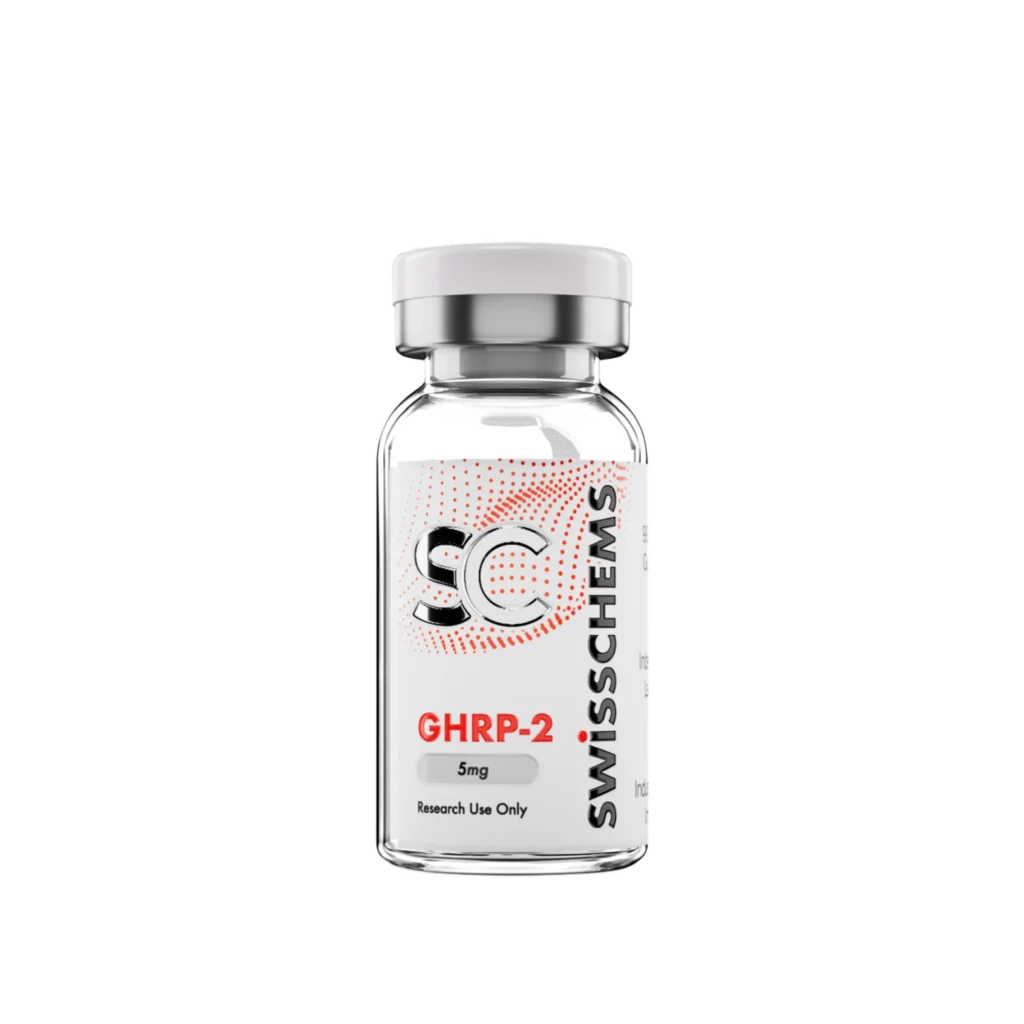
SKU: GHRP25M

Same-day shipping on USA orders placed before 2PM EST.
View Shipping Policy →30-day hassle-free returns on unopened products.
View Returns Policy →Every batch is tested for purity, potency and quality.
View Lab Results →Have a question? Our team is here to help you.
Contact Us →GHRP-2 (Pralmorelin) is a synthetic hexapeptide compound studied for selective ghrelin receptor binding properties and growth hormone secretagogue signalling in experimental models. The compound consists of six amino acids (D-Ala-D-β-Nal-Ala-Trp-D-Phe-Lys-NH2) and is examined for its capacity to engage the GHS-R1a (growth hormone secretagogue receptor 1a) in pituitary and hypothalamic research models. Research applications include ghrelin receptor pharmacology, growth hormone secretagogue pathway studies, and pulsatile GH signalling research.
| Chemical Formula | C45H55N9O6 |
|---|---|
| Synonyms | Pralmorelin, KP-102, D-Alanyl-3-(2-naphthalenyl)-D-alanyl-L-alanyl-L-tryptophyl-D-phenylalanyl-L-lysinamide, UNII-E6S6E1F19M |
| Molar Mass | 817.9865 g/mol |
| CAS Number | 158861-67-7 |
| PubChem CID | 6918245 |
| Total Compound Content | 5mg per vial |
| Shelf Life | 36 months |
No lab reports have been added yet.
GHRP-2 is studied for selective agonist activity at the GHS-R1a (growth hormone secretagogue receptor 1a), which is expressed in pituitary somatotroph cells and hypothalamic nuclei. Cell-based binding assays using GHS-R1a-expressing cell lines, alongside downstream signalling readouts (such as cAMP accumulation and calcium mobilization), are standard methods for characterising GHRP-2's receptor engagement and functional potency relative to other GHS-R1a ligands.
GHRP-2 engages the ghrelin/GHS-R1a receptor pathway, distinct from the GHRH receptor pathway targeted by GHRH analogues such as CJC-1295. Research protocols frequently pair GHRP-2 with GHRH analogues to examine whether GHS-R1a agonism and GHRH receptor activation produce synergistic effects on growth hormone secretagogue signalling endpoints, a common combination design in pituitary pathway research.
Studies investigating GHRP-2 mechanisms typically incorporate vehicle controls, receptor-antagonist controls, and comparator GHS-R1a agonists to distinguish receptor-specific effects from non-specific pathway activation. Comparative experiments using compounds such as GHRP-6 or Ipamorelin are commonly employed to evaluate differences in signalling selectivity, pathway activation patterns, receptor responsiveness, and downstream transcriptional responses. These approaches help establish mechanistic attribution in GHS-R1a pharmacology research.