Shipping
Same-day shipping on USA orders placed before 2PM EST.
View Shipping Policy →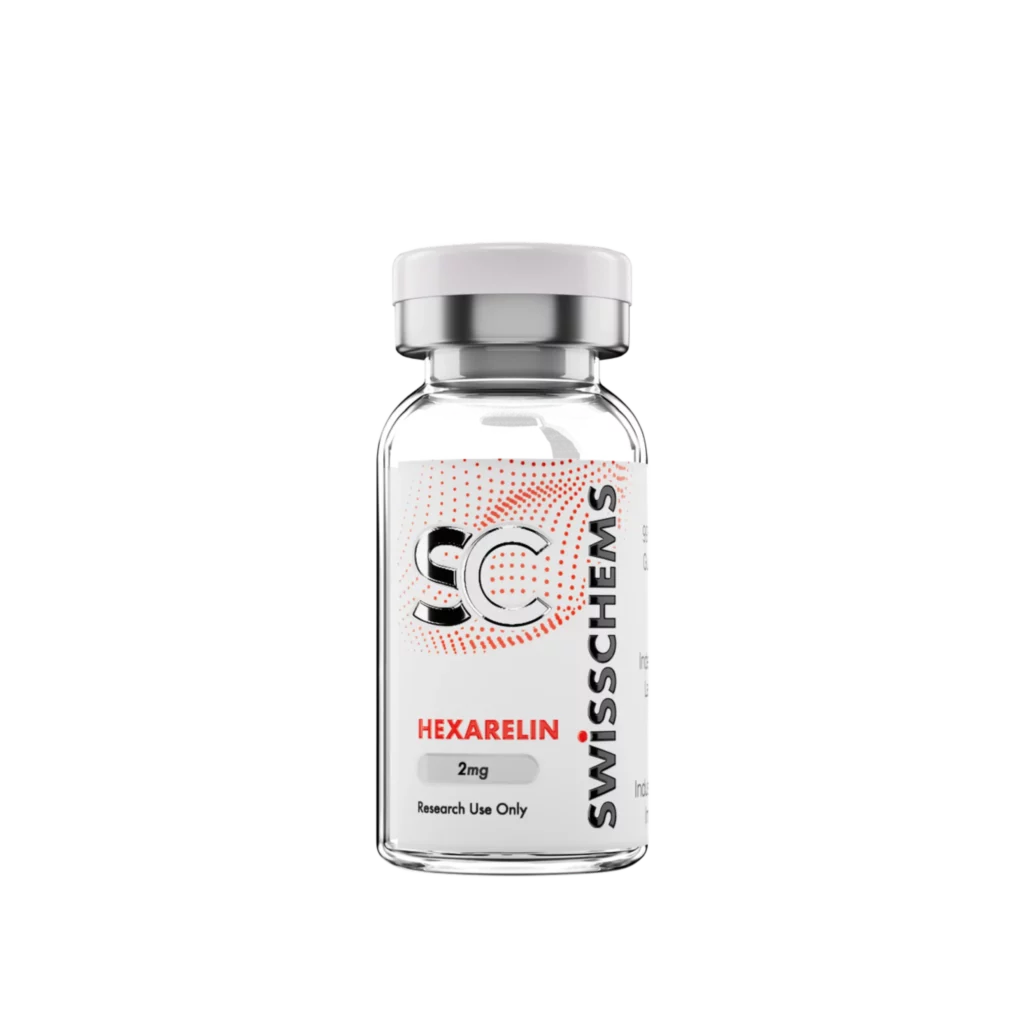
SKU: HEXARLN2M

Same-day shipping on USA orders placed before 2PM EST.
View Shipping Policy →30-day hassle-free returns on unopened products.
View Returns Policy →Every batch is tested for purity, potency and quality.
View Lab Results →Have a question? Our team is here to help you.
Contact Us →Hexarelin (Examorelin) is a synthetic hexapeptide growth hormone secretagogue and one of the most potent GHS-R1a agonists identified. Binding to GHS-R1a activates Gq/11-mediated phospholipase C signalling, resulting in IP3/DAG generation, intracellular calcium mobilization, and downstream secretagogue-associated signalling pathways. Unlike other members of the GHRP class, Hexarelin also interacts with CD36 (scavenger receptor class B), providing a secondary signalling mechanism independent of GHS-R1a activation. This dual receptor profile makes Hexarelin a valuable research tool for investigating GHS-R1a pharmacology, receptor-signalling dynamics, secretagogue potency relationships, CD36-mediated signalling pathways, and comparative peptide pharmacology. Experimental studies have also utilized Hexarelin in investigations of receptor cross-talk, intracellular signalling networks, and peptide-receptor selectivity. Supplied as lyophilized preparation (2 mg/vial).
| Chemical Formula | C47H58N12O6 |
|---|---|
| Synonyms | Examorelin, EP-23905, MF-6003, His-D-2-Me-Trp-Ala-Trp-D-Phe-Lys-NH2 |
| Molar Mass | 887.05 g/mol |
| CAS Number | 140703-51-1 |
| PubChem CID | 6918297 |
| Total Compound Content | 2 mg per vial |
| Shelf Life | 36 months |
No lab reports have been added yet.
CD36 (cluster of differentiation 36), also known as fatty acid translocase (FAT), is a class B scavenger receptor involved in lipid transport, fatty acid uptake, oxidized lipid recognition, and cellular metabolic signalling. Hexarelin is unique among GHS-R1a agonists in that it also interacts with CD36, providing a second pharmacological mechanism independent of growth hormone secretagogue receptor activation. This dual receptor profile makes Hexarelin a valuable research tool for investigating receptor-specific signalling pathways, metabolic regulation, lipid-sensing mechanisms, and the distinction between GHS-R1a-mediated and CD36-mediated biological effects.
Hexarelin is widely regarded as one of the most potent peptide agonists of GHS-R1a. Comparative pharmacology studies frequently utilize Hexarelin as a reference compound when evaluating receptor affinity, agonist efficacy, signalling kinetics, and downstream pathway activation among members of the GHRP class. Its high receptor potency and well-characterized signalling profile have established it as a standard tool in GHS-R1a research and comparative secretagogue pharmacology.
In addition to its role in GHS-R1a signalling research, Hexarelin is used to investigate CD36-associated pathways, receptor cross-talk mechanisms, lipid-regulated signalling networks, cellular stress-response pathways, and comparative receptor pharmacology. The presence of both GHS-R1a and CD36 activity allows researchers to design experiments that differentiate receptor-specific signalling events and examine the interaction between distinct peptide-responsive pathways within the same experimental system.